
A pergola—an open-roofed post-and-beam framework—creates defined outdoor space without full enclosure, allowing airflow and partial shade through its latticed or slatted design. You’ll build one by measuring your area precisely, setting plumb posts in concrete footings, fastening cross beams with galvanized bolts and hardware, then spacing shade slats according to your climate needs. Success depends on accounting for frost lines, wind direction, and soil conditions during planning, then verifying alignment and load capacity before final assembly. The structural fundamentals matter most; everything else—lighting, plants, finishing—builds from that solid foundation.
What Is a Pergola and Why Build One?
A pergola—that open-roofed structure you’ve probably admired in someone’s backyard—is fundamentally a post-and-beam framework designed to create a defined outdoor room without the full enclosure of a traditional roof. You’ll find that pergolas provide partial shade through their cross beams or slats, offering respite from direct sunlight while maintaining airflow and an open aesthetic. Building one transforms your outdoor space into an intentional gathering area, whether you’re following along with a YouTube channel tutorial or working from plans. The appeal lies in their versatility: they’re sturdy enough to support climbing plants or shade cloths, yet simple enough for a capable homeowner to construct. You’re essentially creating a structured extension of your living space—an investment in both functionality and visual appeal.
Pergola vs. Gazebo: What’s the Difference?
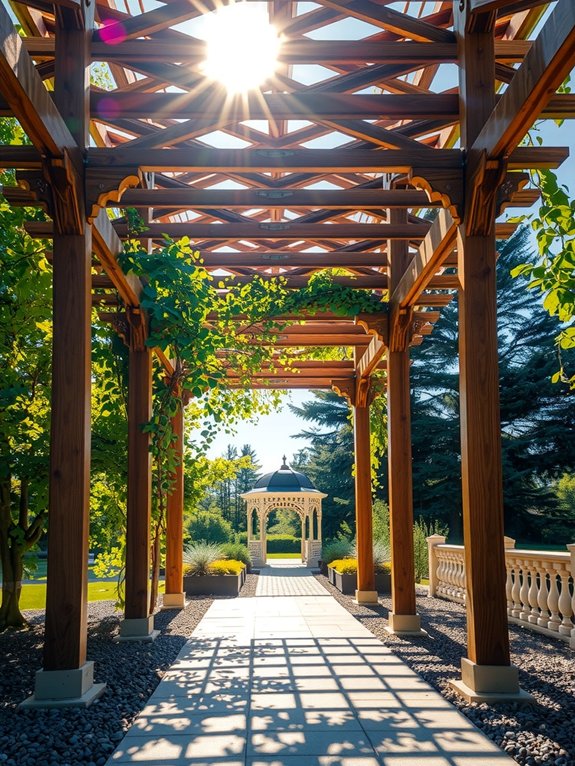
When you’re planning your backyard structure, you’ll likely encounter both pergolas and gazebos, and while they’re sometimes confused with one another, they’re fundamentally different outdoor spaces designed for distinct purposes. Here’s what sets them apart:
- Roof design: Pergolas feature open lattice or slats; gazebos have solid, fully enclosed roofs
- Light and airflow: Pergolas allow sunlight and breezes through; gazebos provide complete shelter
- Structure shape: Pergolas emphasize linear beams and posts; gazebos typically display rounded or polygonal footprints
- Integration: Pergolas often attach to existing homes; gazebos stand alone as independent retreats
- Construction materials: Pergolas use exposed beams; gazebos incorporate walls or screens
Understanding these distinctions helps you choose what actually serves your needs—whether you want dappled shade over a seating area or a fully protected pavilion for gathering, regardless of weather conditions.
Plan Your Size, Location, and Design
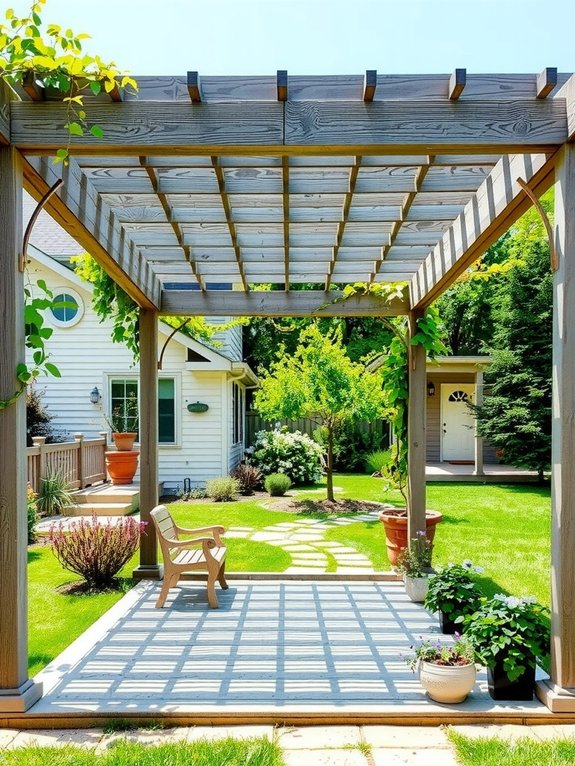
Before you drive the first post hole, you’ll need to measure your intended area with precision—whether that’s a modest 12 by 16 feet or an expansive 12 by 36 feet—and sketch out your design using tools like Google SketchUp or simple pen-and-paper drawings that’ll help you visualize dimensions, post locations, and the overall footprint that’ll guide your framing and spacing decisions. Your local weather patterns, particularly freeze-thaw cycles and rainfall intensity, should directly inform how deep you’ll set those posts and where you’ll position them for maximum stability and longevity, since a pergola built to withstand your climate’s specific demands will outlast one designed generically. Account for your lumber dimensions upfront—considering not just the visual proportions of your beams and posts, but also how you’ll finish them later with sealing or staining—and plan your materials and hardware early, ensuring your design accommodates bolts, washers, and brackets that’ll actually support the structure you’re envisioning.
Measuring Your Desired Area
The foundation of any successful pergola project—and I’ve learned this through more than a few missteps—rests on taking accurate measurements of your intended site, which involves not just determining the overall dimensions you’ll want (say, 12 by 36 feet) but also accounting for how that footprint‘ll sit within your existing yard layout and relate to nearby structures like fences, patios, or the house itself.
Before you break ground, consider these spatial factors:
- Clearance from property lines and setback requirements
- Distance from underground utilities and irrigation lines
- Proximity to trees that might eventually shade or drop debris
- Sight lines from interior windows and outdoor living areas
- Slope and drainage patterns across your chosen location
These measurements, taken carefully with a tape measure and recorded on paper, prevent costly repositioning later and ensure your pergola integrates seamlessly into your landscape rather than competing with it.
Creating Your Design Plan
How you’ll translate those measurements into an actual design—one that accounts for structural demands, aesthetic preferences, and the practical realities of your yard—determines whether your pergola functions as a cohesive addition or an afterthought that fights against your landscape. Sketch your vision using Google SketchUp or simple pen-and-paper drawings, establishing your pergola’s footprint, whether that’s 12 by 36 feet or something more modest for your space. Mark post hole locations based on your planned dimensions and local structural requirements. Consider how weather patterns—rain, wind, snow load—affect post depth and spacing, ensuring adequate drainage beneath the structure. List lumber dimensions, hardware specifications like bolts and brackets, and finishing materials you’ll need. This deliberate planning prevents costly mistakes and builds confidence for construction ahead.
Considering Weather and Conditions
Your sketch’s accuracy means little if you haven’t factored in the environmental forces that’ll test your pergola’s durability—wind gusts that’ll rattle poorly anchored posts, frost heave that’ll shift footings upward during winter cycles, and snow loads that’ll sag an undersized beam. Before you break ground, you’ll want to assess your specific climate:
- Frost line depth in your region, which determines how deep you’ll dig post holes for stability
- Prevailing wind direction and typical speeds, influencing post placement and bracing requirements
- Annual snowfall and rainfall patterns, affecting beam sizing and drainage planning
- UV exposure and temperature swings, which demand protective sealants and pressure-treated lumber
- Soil composition—clay, sand, or rocky terrain—dictating drainage needs and footing conditions
This groundwork transforms your design from theoretical to resilient.
Materials, Hardware, and Budget Breakdown
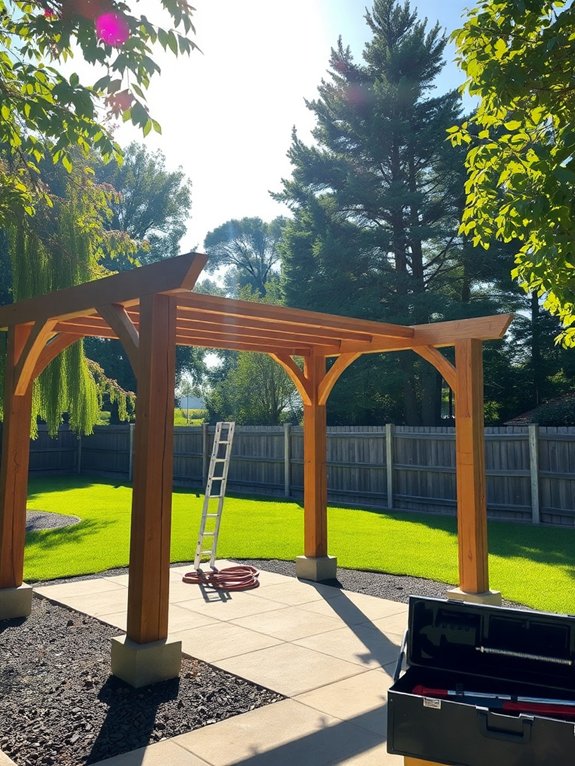
Building out your pergola’s structural integrity and visual appeal comes down to selecting the right materials, hardware, and understanding where your budget’ll actually go—a combination that, when done thoughtfully, yields both durability and the refined aesthetic you’re after. You’ll invest approximately $2,500–$3,500 in lumber alone for a 14.5-by-16-foot structure using 16-foot boards throughout. Simpson Strong-Tie Outdoor Accents hardware—specifically 66 Flat T Straps, 66 Deck Joist Ties, 3½-inch structural screws, hex head washers, and 90º angles—provides the decorative-meets-functional fastening system. The black powder-coated finish handles outdoor exposure while anchoring your central brace, where two 2x6s connect via strategically placed brackets. This hardware approach transforms raw lumber into a cohesive, weather-resistant framework.
Dig and Set Your Foundation Posts
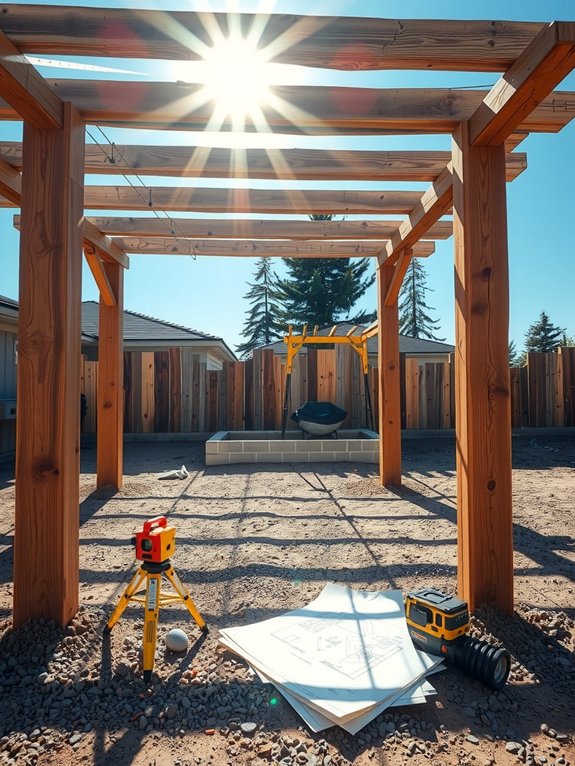
The foundation posts—those six sturdy anchors that’ll carry your entire pergola’s weight—demand the most careful attention you’ll give to this whole project, since a pergola that shifts or settles unevenly becomes a safety liability and an eyesore within a season or two. You’re building the skeletal framework that everything else depends on, which means precision matters.
Start by digging your holes with these steps in mind:
- Dig six post holes approximately 24 inches wide and 30 inches deep, adjusting for your soil conditions and local frost depth
- Line each hole’s bottom with gravel for drainage and a level base
- Use a long level to verify posts remain plumb on all sides
- Temporarily brace posts with 1×2 support pieces during backfill
- Align posts with stakes and masonry line before pouring concrete
Bolt Down Your Cross Beams
You’ll mark the exact location for each cross beam on your posts—a step that’ll save you hours of frustration later—then position your 2x3x12 braces to hold everything steady while you work. Using a long auger bit, you’ll drill through both the beams and posts together, ensuring perfect alignment before you insert your galvanized bolts with washers and nuts, tightening each one until it’s snug but not over-torqued. As you secure these fasteners, you’ll rely on temporary 1×2 supports to keep your posts plumb and beams level, checking your work against your SketchUp plan to catch any drift before you finalize the connection.
Marking Beam Locations
Once your posts are plumb and braced, marking the beam locations becomes your next critical step—one that’ll determine whether your entire structure sits level and true or develops frustrating quirks down the road. You’ll want to establish consistent heights across all posts, using a masonry line and stakes as your reference points. This process demands precision, though I’ll admit the repetition can feel tedious until results prove its worth.
Mark the desired bottom edge of cross beams deliberately:
- Measure from ground level using a tape measure and mark corresponding heights on each post
- Snap chalk lines horizontally across posts to establish visual guides
- Double-check measurements before making permanent marks
- Account for any slope in your foundation or terrain
- Use stakes and masonry line to verify alignment across the entire structure
These marks guide your bolt placement and ensure proper beam positioning throughout installation.
Drilling And Securing
With your chalk lines snapped and measurements verified, you’re ready to drill—the step that locks your cross beams permanently into place and transforms your loose framework into a unified structure. Use a long auger bit to bore through posts and beams, creating clean holes that’ll accommodate your bolts without forcing or stripping. Before final fastening, temporarily brace beams with 2×3 studs, holding everything square while you work. Thread galvanized bolts—complete with washers and nuts—through each hole, then tighten securely until snug. This combination of hardware resists corrosion and deterioration. Verify alignment with stakes and masonry line throughout, confirming plumb and level across all connections. You’re not just fastening pieces; you’re anchoring something built to last through seasons of weather and time.
Space and Screw Your Shade Slats
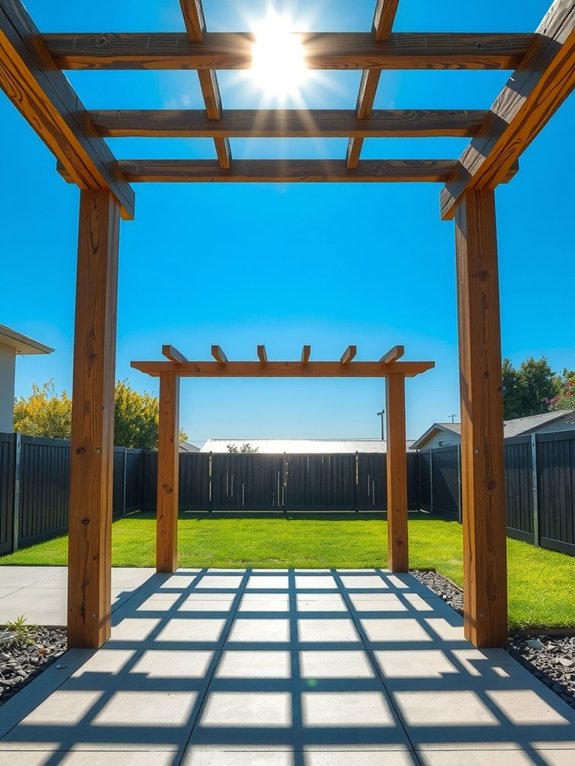
How you space and fasten your shade slats determines not just the pergola’s visual appeal but also its practical function, balancing the dappled sunlight you’re after against the airflow and drainage you’ll need beneath. Your slat spacing typically ranges from narrow to wider configurations, which you’ll adjust based on your climate and preferences:
- 10-inch spacing for denser shade and reduced airflow
- 13-inch spacing for moderate sun control and balanced ventilation
- 16-inch spacing for lighter dappling and maximum drainage
- 45-degree angled screws on each side of shade joists for lateral stability
- Front-to-back alignment checked against your design plans for uniform spacing
Secure your 4x4x12 joists methodically, ensuring each fastener sits flush. This deliberate approach prevents the lateral movement that’ll plague you later, transforming your structure into something genuinely reliable.
Stain, Seal, and Protect Against Weather
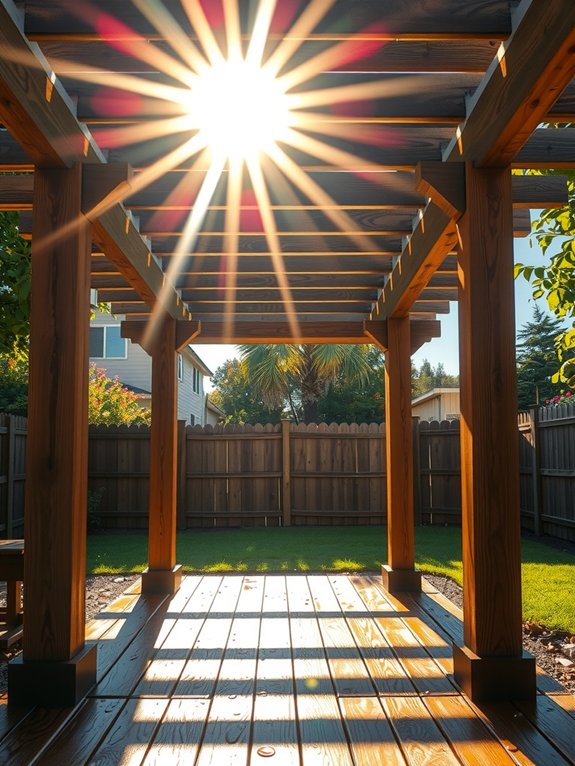
Once you’ve assembled your pergola’s framework and installed the shade slats, you’ll need to protect all that exposed wood from the relentless combination of moisture and UV rays that’ll degrade it over time. You’ve got to choose a finish—whether that’s a stain that lets the wood grain show through or a sealant that sits on top—that matches your desired look, and it’s worth testing a small sample first to confirm the color and how deeply it penetrates before you commit to treating your entire structure. Sealing the bottom portions of your posts, particularly those 12 to 24 inches that’ll sit closest to ground contact or moisture wicking, before you even install them makes the difference between a pergola that needs refinishing every couple of seasons and one that’ll hold up for years with just occasional maintenance.
Choosing The Right Finish
After you’ve built your pergola’s structure, the real work of preservation begins—because untreated wood, no matter how sturdy the framing, won’t last long under sun, rain, and temperature swings. You’ll want to select a finish strategy that matches your climate and maintenance tolerance, considering these proven approaches:
- Clear or semi-transparent stains that reveal wood grain while offering UV protection
- Solid-color stains that hide aging and weathering between applications
- Penetrating stains followed by protective topcoat sealants for layered defense
- Pressure-treated lumber combined with brown stains for enhanced durability
- UV-rated finishes applied to vulnerable areas, particularly the bottom 24 inches of posts
This two-step treatment—stain plus sealant—creates lasting weather resistance, though you’ll need to reapply every 1–3 years depending on exposure and rainfall patterns.
Sealing Lumber Before Installation
Why seal lumber before you even drive the first fastener? Because unprotected wood absorbs moisture relentlessly, warping and splitting in ways that’ll haunt your pergola for years. You’ll want to apply a penetrating, water-repellent stain or sealer—one labeled for exterior use with UV protection and mold resistance—to all six sides of your lumber, including the often-neglected ends where moisture penetrates fastest. Pay particular attention to the bottom 24 inches of vertical posts, since ground moisture causes the most severe rot. Time your sealing after the wood’s acclimated to your climate but before assembly, ensuring even penetration throughout. Follow the manufacturer’s reapplication schedule religiously. This deliberate prep work transforms lumber into something genuinely durable.
Long-Term Weather Protection Strategy
How many pergolas have you seen where the wood’s turned gray and splintered, its protective finish peeling away in sheets? You can prevent this decay by establishing a deliberate, multi-year protection strategy that guards against moisture infiltration and UV damage.
Your maintenance approach should include:
- Applying penetrating, UV-resistant stain to all exterior surfaces before installation
- Prioritizing the bottom 24 inches of posts, where ground moisture poses the greatest risk
- Sealing end cuts aggressively, since exposed wood grain absorbs water rapidly
- Choosing breathable, semi-transparent sealants that allow wood grain visibility while repelling water
- Resealing every 2–3 years, adjusting frequency based on your climate’s severity
Annual inspections—checking for loose fasteners, damaged joists, and peeling finish—keep your pergola structurally sound and visually intact for decades, transforming seasonal maintenance into genuine stewardship of your outdoor structure.
Pergola Building Mistakes to Avoid
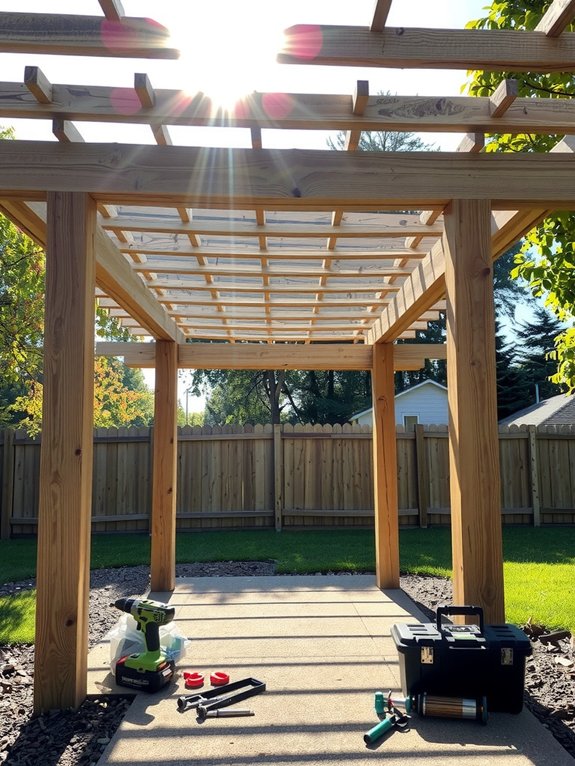
Once you’ve committed to building a pergola, the structural integrity of your project hinges on decisions made during the foundation phase—decisions that, if overlooked or rushed, ‘ll undermine months of planning and labor. Post holes demand 24″–30″ depth with precise spacing calibrated to your design loads; shallow or misaligned holes invite wobbling that compounds over seasons. You’ll maintain plumb posts using a long level and temporary braces, holding them steady until concrete fully cures. Neglecting drainage and gravel at hole bottoms allows moisture infiltration, causing settling and instability. Before final bolt-tightening, verify cross beam and shade joist alignment to prevent warping. Select galvanized hardware compatible with your materials—non-galvanized brackets corrode internally, compromising load transfer and durability silently.
Verify Stability and Load Capacity
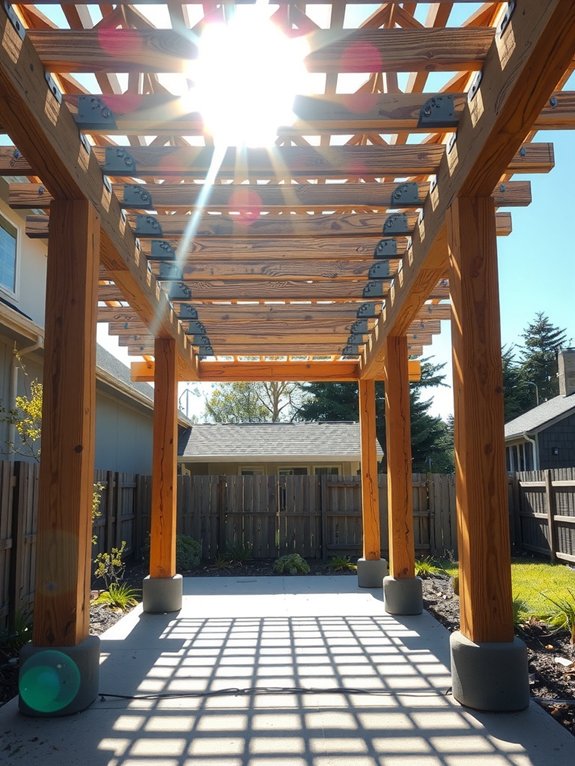
The foundation work you’ve completed—those plumb posts set in properly cured concrete, the gravel base protecting against frost heave, the hardware selected for galvanic compatibility—now demands verification before you proceed with framing. Your next steps require methodical assessment:
- Use a long level on all post faces to confirm plumb alignment, which prevents lateral stress concentration
- Stretch a taut mason’s line between posts to verify they’re truly vertical and properly spaced
- Calculate tributary area for your 14.5–16 ft span to determine actual load requirements
- Select galvanized bolts with washers and nuts rated for both live and dead loads anticipated
- Install center braces—those 2x6s with 90-degree brackets—to transfer beam loads downward and resist lateral movement
This verification work, though seemingly tedious, separates solid structures from those that fail under snow or wind load.
String Lights and Overhead Fixtures
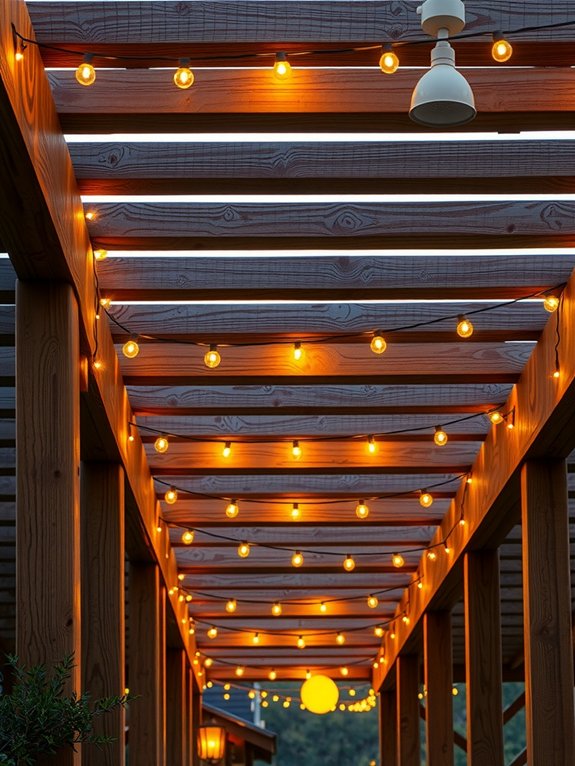
Why settle for a pergola that disappears into darkness once the sun dips below the horizon, especially when you’ve invested months in its construction and stability? String lights transform your structure into an inviting evening gathering space, extending its usability well past sunset. I’ve found that spacing weatherproof LED fixtures eight to twelve inches apart along the top cross beams creates balanced illumination across your seating area. Installing them with outdoor-rated light clips or zip ties prevents wire sag while protecting cords from moisture damage. Low-voltage or battery-powered options paired with weatherproof transformers offer both safety and energy efficiency—qualities that matter when you’re building something meant to last. This approach respects the structural integrity you’ve established while completing your pergola’s purpose as a genuine outdoor room.
Climbing Plants and Greenery
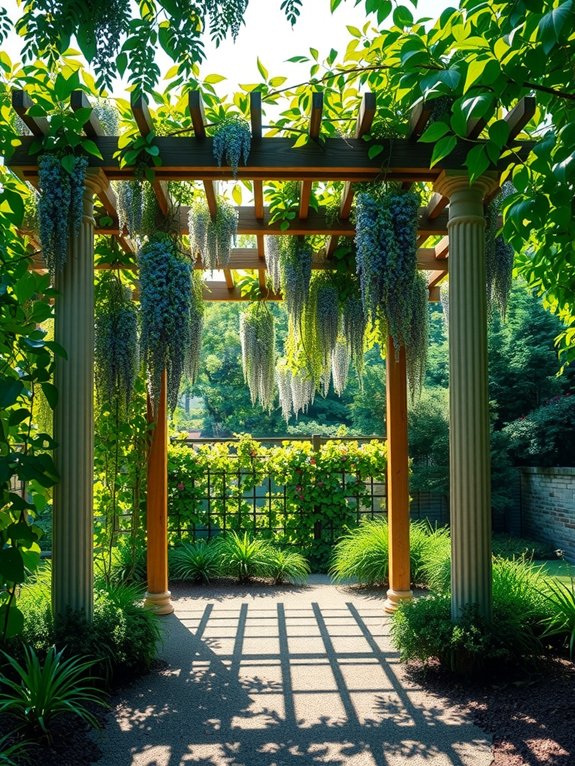
Your pergola’s structural skeleton, however well-engineered, remains incomplete until you’ve clothed it with climbing plants—the living elements that transform bare wood into a verdant retreat. You’ll find that strategic planting creates the intimate space you’ve envisioned, offering shade, fragrance, and visual richness that elevate your outdoor experience.
A pergola’s true potential awakens when clothed with climbing plants—transforming bare framework into a verdant, fragrant sanctuary.
Consider these proven performers:
- Wisteria with cascading flower clusters demanding sturdy support
- Clematis offering abundant blooms in multiple color varieties
- Trumpet vine delivering vigorous coverage and bold flowers
- Climbing roses combining romance with reliable growth
- Jasmine providing intoxicating fragrance throughout seasons
You’ll want at least six hours of sunlight, well-drained soil, and initial training using soft ties to guide growth upward. Regular pruning manages weight while removing deadwood, ensuring your climbing plants enhance rather than overwhelm the framework you’ve built.
Pergola Maintenance and Long-Term Care
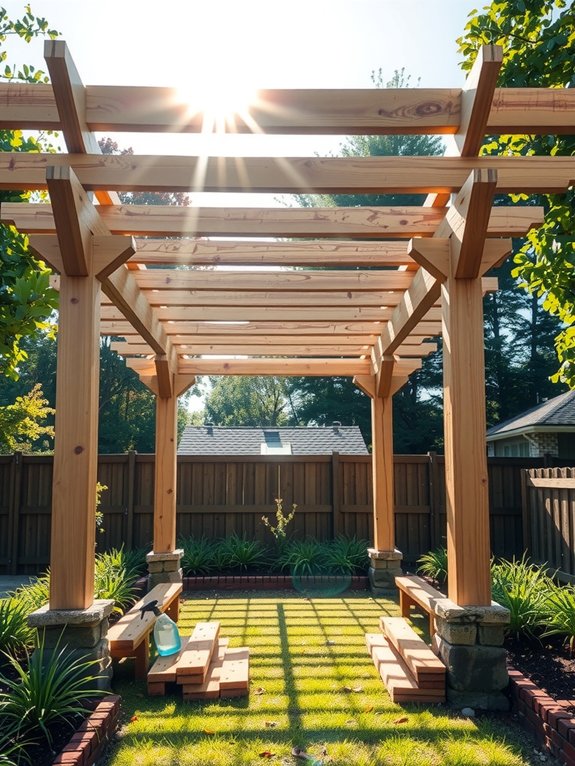
Once you’ve established your pergola as a living structure clothed in climbing vines, you’ll discover that the real work—the patient, seasons-long commitment to preservation—begins in earnest. You’ll need to develop a maintenance rhythm, one that acknowledges the particular vulnerabilities your structure faces. Regular cleaning with mild soap and water prevents mold and mildew from taking hold in shaded, humid zones. Annually, inspect and tighten all hardware—bolts, screws, brackets—to maintain structural integrity against wind and weather’s persistent pressure. Every two to three years, re-seal or re-stain wooden surfaces, protecting against UV damage and moisture intrusion. Check post footings and concrete for cracks or settling each season, addressing movement promptly. Clear debris and ensure proper drainage around your pergola’s base, keeping wood separated from standing water that breeds rot.