Traditional pergolas block about 40 to 60 percent of sunlight through their open slats, which means you’ll get dappled light instead of solid shade. On bright afternoons, you’ll notice right away that standard slatted designs don’t provide complete coverage. If full shade matters to you, you have options. Adjusting how close together your slats are, training climbing vines across the structure, or adding fabric canopies will all increase how much shade you actually get. How much protection you experience depends on several factors that change throughout the day and seasons—mainly the sun’s angle, how thick your slats are, and what your local climate does.
How Much Shade Does a Traditional Pergola Actually Block?
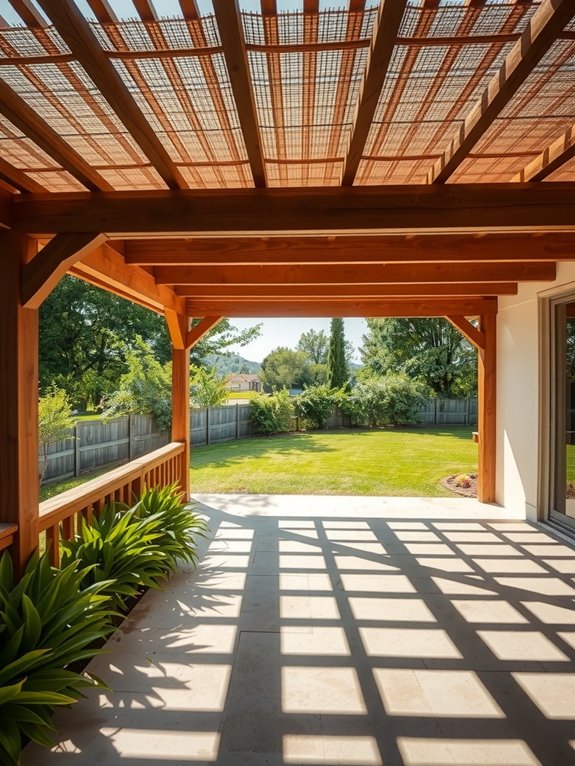
When you’re standing beneath a traditional pergola on a bright afternoon, you might wonder how much sun it actually blocks. The answer usually falls somewhere between 40% and 60% shade, depending on how tightly your slats are spaced and which direction you’re facing.
How much shade you get depends directly on two things: how close together your slats are and what angle the sun is hitting them. Closer slats naturally block more light than widely spaced ones. Your open slats do let air flow through and give you some see-through appeal, but that design choice means you won’t get maximum shade without making some changes.
If 40% to 60% shade isn’t quite enough for your needs, you have options. You can layer additional shading methods on top of your pergola structure. Climbing vines add natural coverage that increases over time. Fabric canopies give you adjustable shade that you can deploy when you need it most. Retractable louvers let you control exactly how much light comes through. These additions push your pergola’s effectiveness well beyond what the slat construction alone can provide.
Why Do Open Slats Create Dappled Light Instead of Full Coverage?
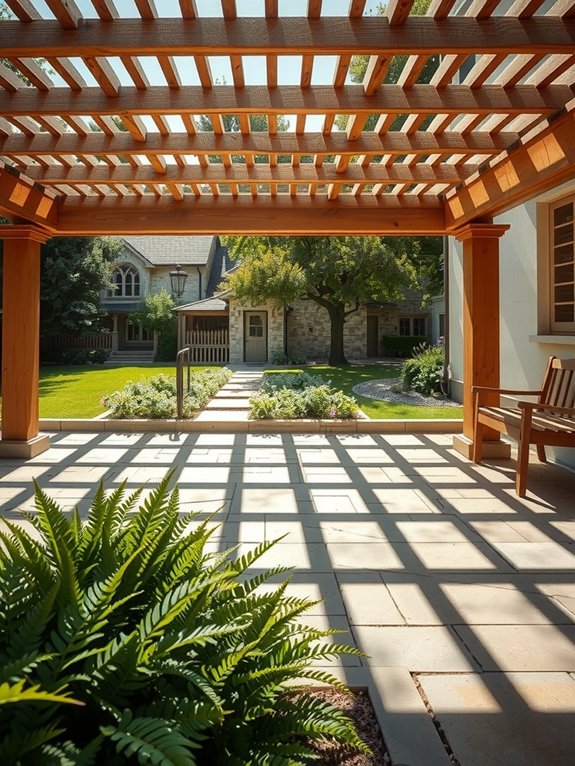
Open slats create dappled light instead of full shade because of how the gaps work with sunlight. As the sun hits your slats at different angles, some rays pass through the gaps while others get blocked. The result is those scattered patches of light and shadow on the ground below, rather than one solid shaded area.
The spacing between your slats matters a lot here. Slats that are close together let less light through, while widely spaced slats allow more sunlight to reach the ground. Your choice of material also plays a role—wood absorbs more light than aluminum does, so wooden slats will cast darker shadows. How thick each slat is makes a difference too, since thicker materials block more rays than thinner ones.
What you see changes throughout the day as the sun moves across the sky. When the sun is low on the horizon, it hits your slats at a steep angle and creates longer, more dramatic light patterns. When the sun is directly overhead, the light pattern shifts and becomes more compact. This constant movement means your shaded area won’t look the same at 9 a.m. as it does at 3 p.m.
Whether this dappled effect works for you depends on what you need the shade for. If you want consistent, full coverage, open slats won’t deliver that. But if you’re okay with variable light and shadow throughout the day, you get a natural pattern that looks interesting without creating heavy, unchanging darkness.
How Light Filters Through
Why does standing beneath a pergola feel so different from sitting under a solid roof or dense tree canopy? The answer is in how sunshine interacts with your pergola’s slats. When sunlight hits the open spacing between slats, it doesn’t block rays entirely. Instead, it breaks them up into fragments. You’re getting filtered light rather than continuous shade.
The sun’s rays pass through gaps at different angles, which creates that characteristic dappled light pattern across your skin and the ground around you. Your shade intensity depends directly on how close together your slats are. Closer spacing produces deeper shade and blocks more direct sunshine, while wider gaps let in brighter patches. This partial obstruction stops some UV rays but lets others through, giving you filtered light that shifts as the sun moves across the sky throughout the day.
Sun Angle and Spacing Effects
The dappled light pattern under your pergola follows predictable rules based on two main factors: how you space your slats and where the sun sits in the sky at any given time.
Your slat spacing is the first control lever. Close the slats together and you get denser shade with less direct sun hitting the ground below. Open them wider and more light filters through, creating those alternating strips of brightness and shadow that make pergolas visually interesting. It’s a straightforward trade-off—tighter spacing means cooler, darker conditions underneath.
The sun’s position throughout the day shifts everything. When the sun sits high overhead at midday, you get smaller, more concentrated patches of light and shade. During morning and evening hours, that lower angle throws longer, more dramatic shadows across your space. If you’ve tilted your slats at an angle, you’re essentially fine-tuning this effect, deciding how much of that filtered light actually reaches down to where you’re sitting.
Getting these mechanics right means you can design a pergola that actually works for your comfort needs rather than guessing whether you’ll have enough shade or too much.
Creating Natural Dappled Patterns
Instead of a solid canopy overhead, open spaces let sunlight beam straight through and cast distinct shadows on the ground below. You might expect partial coverage to create uniform half-shade, but that’s not what happens. The dappled effect occurs because light travels in straight lines, and your slat spacing determines exactly how those lines break up into separate patches of light and dark.
Here’s how spacing works: narrower slats create denser shadow patterns with smaller light gaps, while wider slats produce airier, more scattered illumination. As the sun moves throughout the day, your shade pattern shifts continuously, changing the overall effect.
You can intensify the dappled look by adding climbing plants or layering your lattice. These additions create more light-filtering surfaces and deepen the shadow patterns while keeping the airflow that makes pergolas practical and appealing.
How Slat Spacing, Angle, and Sun Position Control Your Shade
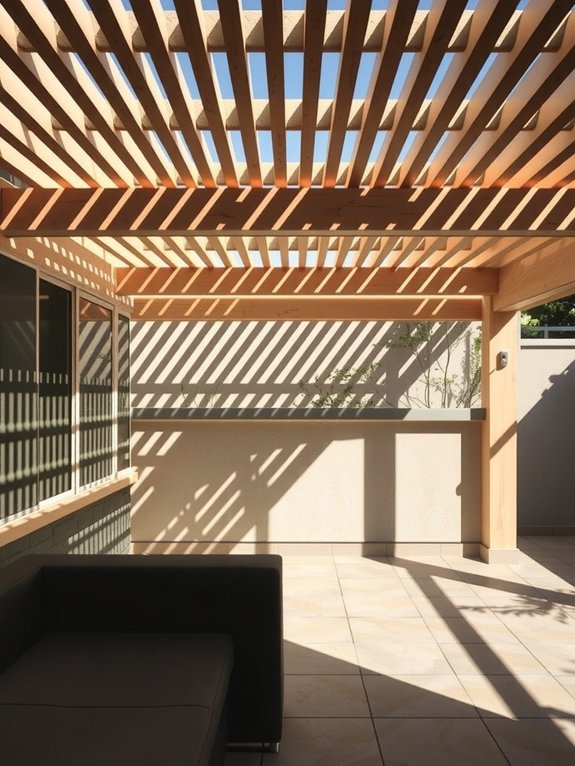
How much shade you’ll actually sit under depends far less on whether you’ve built a pergola than on how you’ve configured it. Three specific factors control your results: the spacing between your slats, their angle relative to the sun, and where that sun is in the sky at any given moment.
Close slat spacing reduces light transmission substantially, which deepens your shade and minimizes glare. Wider gaps allow more brightness through, so you’ll need to decide how much light you want filtering down. Your slat angle matters enormously too. When you tilt them strategically, they capture the sun’s shifting positions throughout the day, maximizing shade depth during peak hours. An adjustable louvered roof gives you the most control—it tracks the sun’s arc so you can adjust coverage as the day progresses.
Understanding how these variables work together transforms your pergola from a decorative structure into a genuinely functional outdoor shelter that actually does what you need it to do.
Growing Natural Pergola Shade With Climbing Plants Over Time
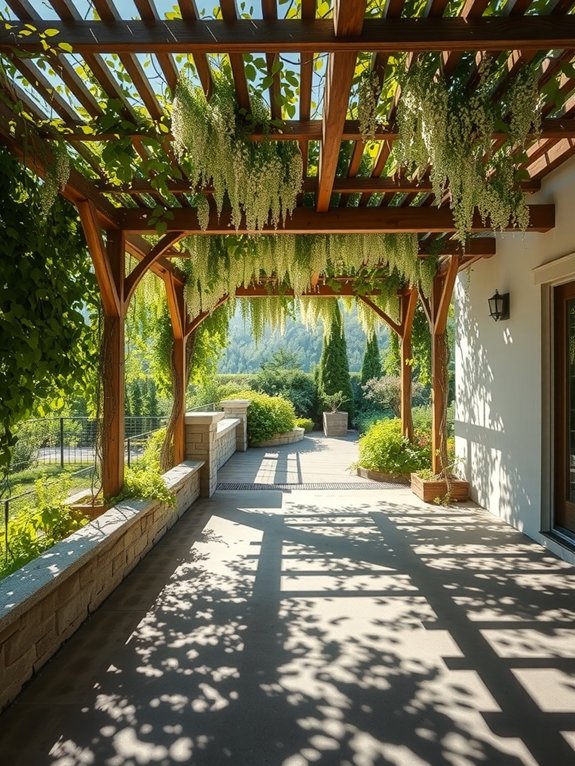
Climbing vines like clematis, ornamental grapes, and wisteria will reshape how much shade your pergola provides as months pass. The fast-growing varieties give you coverage sooner, while wisteria takes longer but creates a more dramatic effect. What makes this different from a solid roof is that you get dappled, filtered light instead of uniform darkness underneath.
Here’s the thing about vine-covered shade: it changes with the seasons. Your plants build up density through spring and summer as they leaf out, then thin back down when fall and winter arrive and the vines go dormant. This means you’re trading year-round consistency for a gradually deepening canopy that needs your attention and regular training to develop properly.
Beyond the shifting light patterns, there’s a cooling effect that goes beyond just blocking sun. The plants release moisture into the air—a process called evaporative cooling—which makes the space underneath feel noticeably cooler than full sun exposure. You might notice this temperature difference even when the shade coverage doesn’t look that heavy to your eye.
Vines Create Dappled Shade
When you’re ready to transform a bare pergola into a shade structure, climbing vines offer a practical and elegant solution. You get a living canopy that develops gradually over seasons and years. Unlike solid panels, vines create dappled shade—that filtered, shifting light you’ve probably noticed under mature trees.
As grape, wisteria, or climbing roses grow, their leaves emerge and spread out, letting sunlight through in patterns rather than blocking it completely. This means your pergola actually responds to what you need throughout the year. You’ll get fuller coverage during summer when the heat is strongest, then lighter shade as autumn arrives and leaves drop. The result is gentle, natural light filtration that feels comfortable rather than heavy.
Popular Plant Options Available
Several climbing vines can work really well for your pergola, and each one brings something different to the table depending on where you live and what conditions you’re working with.
If you want sun-loving climbers for your overhead cover, here are some solid options:
- Grapes — these vigorous vines give you fruit production and plenty of shade density as they grow through the seasons
- Wisteria — you get cascading flowers with dense foliage that fills in quickly on trellises
- Jasmine — these flower and smell great, and they don’t ask for much maintenance in warm climates
- Climbing roses — they look good and provide reliable coverage as they get established
The key is picking fast-growing varieties that match your region’s soil and climate. These plants take time to develop, building frameworks that gradually fill your pergola’s lattice. As they mature over successive growing seasons, the shade they provide moves from dappled light to genuine shelter.
Seasonal Growth and Evolution
Once you’ve selected your climbing plants and installed them on your pergola structure, the real work begins—mostly on the plants’ part, as the vines start a multi-year journey that’ll change how much shade your overhead provides.
At first, you’ll see dappled light filtering through sparse coverage. The vine canopy is still pretty modest during this early transition phase. As seasons pass, growth picks up during peak months, building denser foliage that gives you noticeably more shade. Winter thins things out again, exposing the pergola’s framework underneath.
Motorized Louvered Pergolas: Shade on Demand
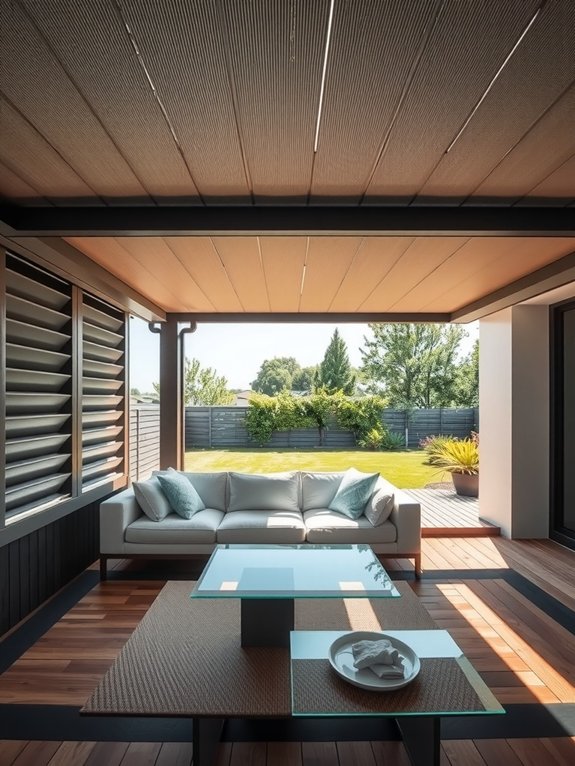
How much control do you actually want over your outdoor comfort? Motorized louvered pergolas give you exactly that—adjustable aluminum slats you can tilt to whatever angle works best for you, shifting throughout the day as the sun moves across the sky.
You get several practical features with these systems:
- Remote control or smart home integration so you’re not manually adjusting anything
- Preset settings already calibrated for morning, noon, and evening sun angles
- Weather sensors that automatically close the louvers when wind or rain hits
- Flexible shade options ranging from nearly complete coverage to partial ventilation
The design actually matters here. Tilted louvers cut down on direct sun while keeping air moving through, which creates real comfort instead of turning your space into a hot, stuffy box. Your pergola responds to what’s happening around it rather than staying fixed in one position, which means your outdoor area genuinely becomes a place you can use throughout the day without constantly fiddling with settings.
Shade Cloth and Fabric: Budget-Friendly Quick Coverage
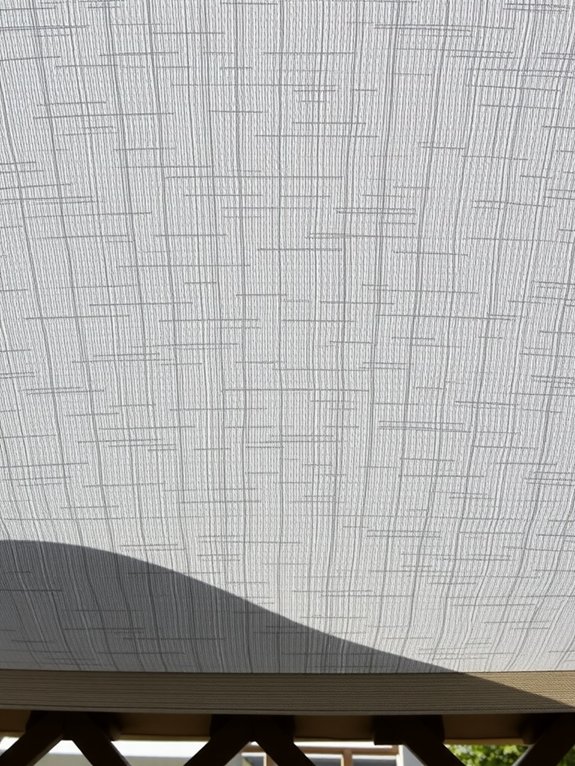
Shade cloth and fabric won’t give you the convenience of motorized systems, but they’ll save you money and keep things simple. The UV protection you get depends on how tightly the fabric is woven and how dense it is, so you can pick exactly the level of shade you need.
Installation is straightforward enough for a DIY project. You probably already have the basic tools and hardware sitting in your garage. If you want something that lasts longer in intense sun, polyester blends and HDPE materials hold up better over time, though they cost more upfront.
The real advantage of fabric coverage is how flexible it is. You can tighten or loosen it with the seasons, switch out fabrics if you want different coverage, and change your setup without making permanent changes to your outdoor space. This makes shade cloth a practical first step if you’re building out your outdoor area gradually.
How to Layer Canopies, Plants, and Fabric for Custom Coverage
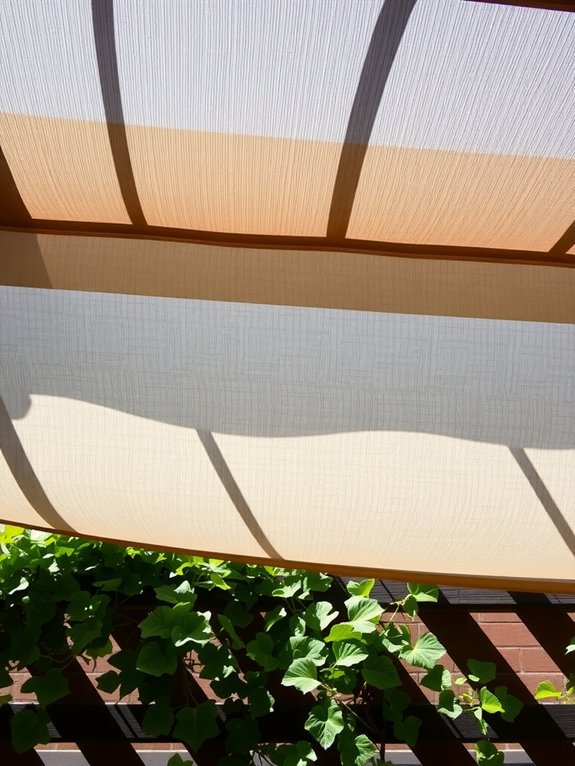
If you’ve found that a pergola’s open lattice alone doesn’t give you enough shade, layering different elements together is your best option. You can combine retractable canopies, climbing plants, and fabric panels to adjust your coverage based on the season and time of day.
Here’s how you can approach layering:
- Retractable canopies roll out when the sun is strongest, then pull back in when you want more natural light coming through
- Climbing plants such as grape vines or wisteria grow over your trellises and create a living canopy that changes with the seasons
- Fabric canopies and side curtains cut down on glare and give you more privacy along the edges of your pergola
- Dense slat arrangements paired with vines give you almost complete coverage during the summer months
This tiered setup lets your pergola adapt to what you need throughout the year, adjusting between partial and nearly full shade as conditions change.
Shade Density Trade-Offs: When Partial Protection Fits Your Needs
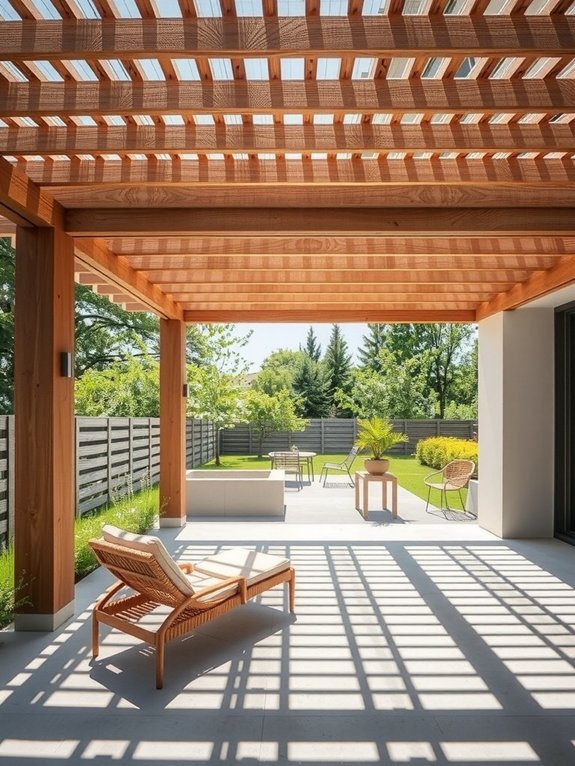
Once you’ve layered your pergola with plants, fabric, and adjustable elements, you’ll face a key decision: how much shade do you actually need. It’s worth thinking about because full blockage—achieved through dense lattice or tightly spaced louvered panels—can trap humidity and cut off the airflow you were hoping for. That’s where partial protection comes in. The 40-60% shade range that open rafter designs naturally provide often works best for most spaces, especially when the sun angle changes throughout the year. You can dial in the right amount by adjusting slat spacing gradually or experimenting with removable fabric. This approach lets you find the shade density that fits your climate and comfort while keeping that breezy, open feeling that makes a pergola actually pleasant to spend time in.
Maintenance by Shade Type: Pergola Fabrics, Plants, and Hardware
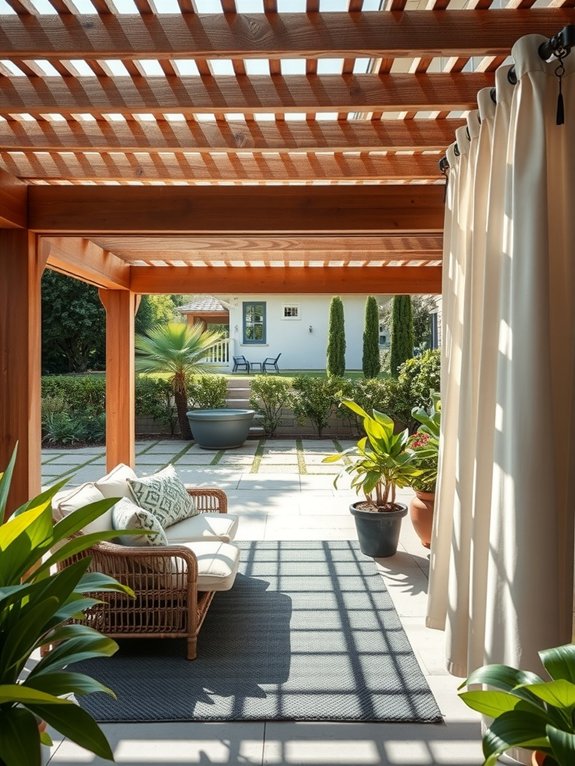
Maintenance by Shade Type: Pergola Fabrics, Plants, and Hardware****
How you’ve chosen to shade your pergola—whether through fabric, vegetation, or mechanical systems—determines what you’ll actually need to do to keep it working season after season.
Your maintenance commitment varies substantially based on your shade choice:
- Shade fabrics like HDPE block up to 93% of UV rays but require annual inspection for tears and weatherproofing degradation
- Plant-based options demand consistent pruning, training, and trellising to sustain effective seasonal coverage
- Hardware systems, including motorized canopies and louvres, necessitate regular gear lubrication and slat alignment checks
Wood surfaces need periodic sealing and resealing to prevent warping and maintain UV protection. Aluminum and vinyl attachments offer lower-maintenance weatherproofing alternatives, though fasteners and seals still require annual verification.
Before you commit to any system, think about what actually fits your schedule. Some shade options need attention every few weeks, while others require just seasonal check-ins. Picking something that matches your real availability matters more than selecting whatever looks best in a catalog.
Matching Shade Methods to Your Climate
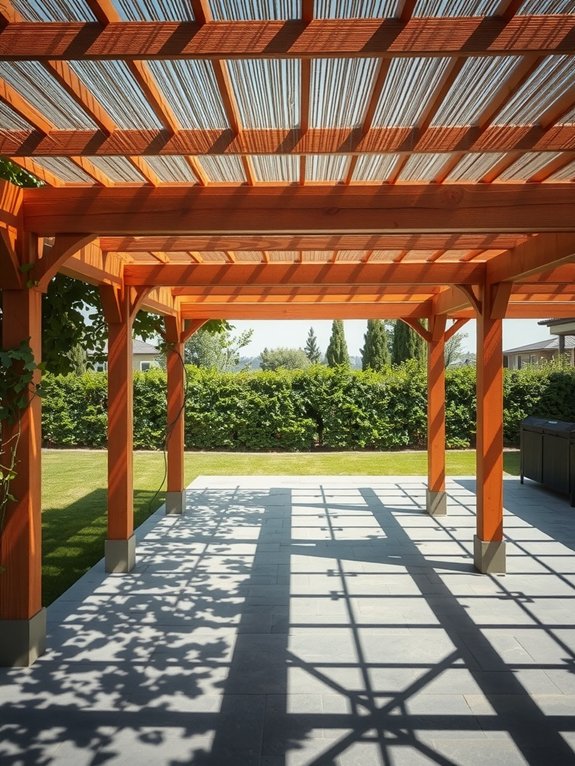
Your climate fundamentally shapes which shade method will actually work for you. In hot, dry regions, you’ll want UV-resistant fabrics or aluminum louvers that can handle intense sun and wind while keeping air moving through your space. If you live somewhere rainy, louvered systems give you flexibility—you can adjust them to shed water while still letting dappled light through on overcast days.
For consistently scorching areas, motorized tilt-ready louvers track the sun as it moves, giving you that reliable 6-degree temperature drop that fixed slats can’t quite match, especially when you pair them with heat-reflective materials built to resist UV damage. In wetter regions where humidity stays high and direct sun is less of a problem, climbing vines and fabric covers work differently. They cool through evaporation, which is something synthetic options simply don’t do, though you’ll need to handle seasonal maintenance to keep them in shape.
Hot Climate Solutions
The challenge with designing pergolas in hot climates isn’t just about blocking the sun—it’s about doing so without sacrificing the airflow that makes outdoor spaces bearable during peak heat. You’ll find several proven solutions that balance shade and ventilation effectively.
Louvered roof systems with motorized, tilt-able slats let you adjust coverage while maintaining airflow, then close completely during rain. This gives you control over how much sun reaches your space depending on the time of day and season.
Shade cloth or tension fabrics filter substantial UV rays while preserving visibility and ventilation at a reasonable cost. These materials work well if you want something less permanent than a roof system.
Retractable canopies provide flexible protection, offering full shade during peak heat and openness when cooler breezes arrive. You get the benefit of adapting to changing conditions without installing a fixed structure.
Vine shade from grapevines and wisteria creates natural cooling as plants mature over seasons. This approach takes time to establish but works well if you’re willing to wait for the plants to fill in.
Solid roof panels work year-round but reduce natural light considerably. Your choice depends on balancing protection, airflow, and the specific conditions your outdoor living space experiences.
Rainy Region Recommendations
Rainy Region Recommendations
Rainy climates need a completely different strategy than what works in dry areas. Instead of focusing on airflow like you would in an arid zone, you’re dealing with water management and keeping your structure sound.
Solid roof panels and waterproof shade options—especially polycarbonate canopy panels—give you the rain protection you need while still letting natural light through. If you want something that handles humidity better, aluminum pergolas with sealed surfaces are worth considering. Louvered pergolas give you adjustable coverage, and motorized louvers or retractable canopies step things up during heavy downpours.
If you prefer layering your shade, combine lattice with fabric canopies. This approach keeps some air moving during lighter rain while cooling your space. Just keep in mind that year-round precipitation makes fixed roofs your best bet. Seasonal solutions tend to develop leaks over time, so investing in permanent coverage makes sense for your climate.
The bottom line is matching your shade solution to what your specific region actually gets. There’s no one-size-fits-all approach, so think about your local rainfall patterns and humidity levels when you’re deciding between options.