
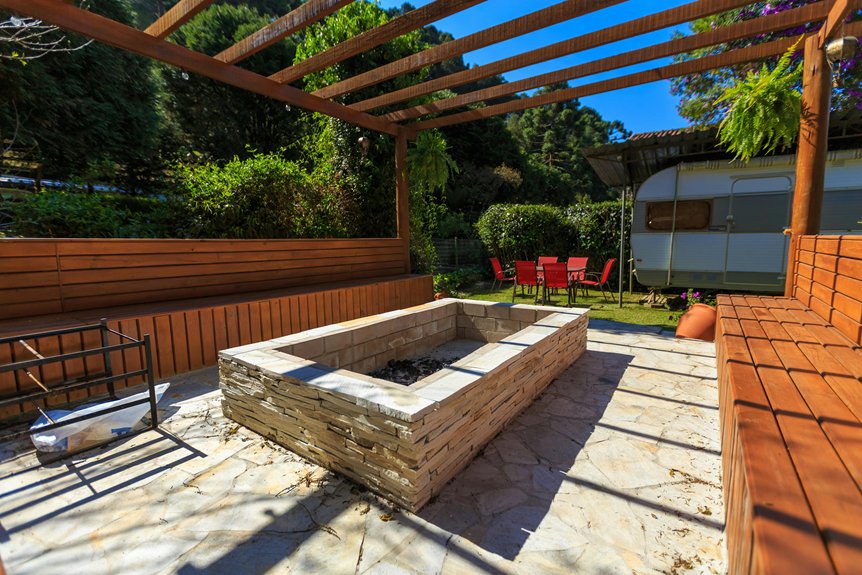
You’ll start by measuring your footprint and sketching a design that respects frost depths and local codes. Then gather pressure-treated lumber, galvanized hardware, and power tools before you begin the actual work.
Dig six holes thirty inches deep for your posts. Set them plumb with concrete footings and brace them while the concrete cures—this step takes a few days, so plan accordingly.
Once your posts are solid, bolt beams to them and attach shade joists sixteen inches apart. Seal everything against moisture to extend the life of your structure.
The final phase involves training climbing vines across the pergola. Wisteria and trumpet vine both work well for this purpose. You’ll want to prune regularly to manage the weight of the vines and keep them from overwhelming the frame.
Choose Your Location and Measure Your Space
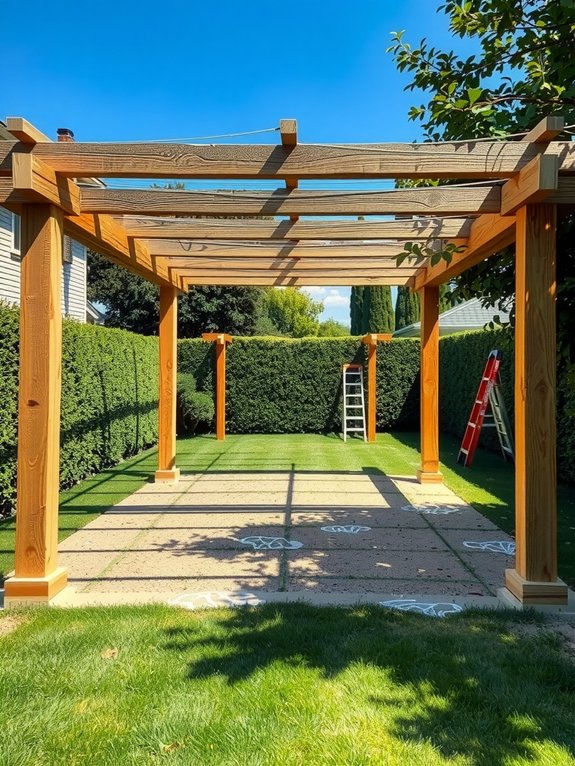
Before you drive a single stake into the ground, you need to spend time planning your pergola‘s footprint. Moving posts after you’ve poured concrete isn’t practical, so get this right the first time.
Before driving stakes, plan your pergola’s footprint carefully—moving posts after pouring concrete isn’t practical.
Start by measuring your desired area carefully. Standard pergola dimensions like 12 x 36 feet or 14.5 x 16 feet work well for most yards, but your actual size depends on your space and what you want. Sketch out a design plan that shows your yard’s layout and marks where you’ll dig post holes.
Check your local frost depth requirements and building codes before you dig. These rules tell you how deep your posts need to go, especially if you’re attaching the pergola to your house. Mark each post location with stakes, spacing them equally so your pergola looks balanced and proportional.
This planning step might seem straightforward, but it’s absolutely critical. Taking time now prevents expensive mistakes later and gives your entire project a solid foundation.
Design Your Pergola and Create a Materials List
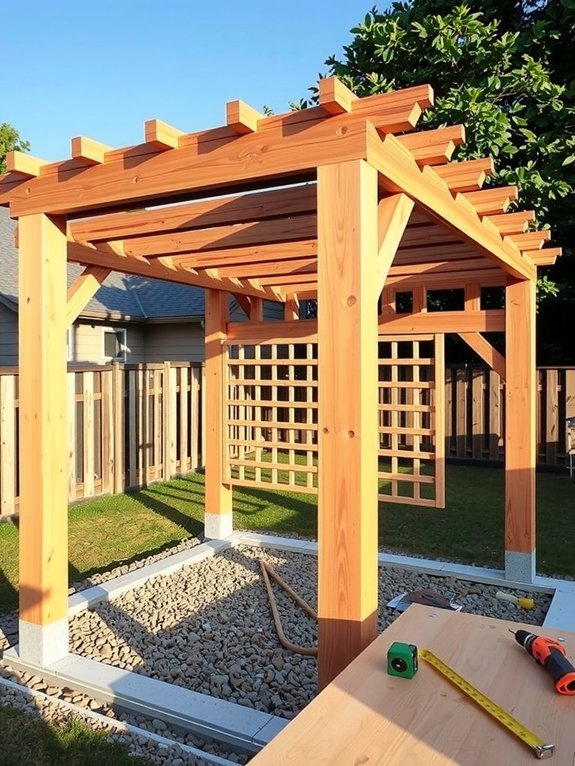
Now that you’ve figured out where your pergola goes and how deep to dig your posts, it’s time to design the actual structure. This is the part where good planning either saves you headaches or reveals mistakes you’ll wish you’d caught sooner. Sketch out your pergola using Google SketchUp or just paper and pencil, and mark down your dimensions—something like 12 x 36 feet works well. Make sure your posts line up exactly with your stakes and masonry lines.
| Material | Quantity |
|---|---|
| 4×4 Posts | 6-8 |
| 2×8 Beams | 4 |
| 2×10 Joists | 12-16 |
| Flat T Straps | 66 |
| Structural Screws | 200+ |
Use pressure-treated lumber for durability. Brown-stained varieties handle weather well and look good doing it. Before you buy anything, write down every single component you’ll need—bolts, washers, post bases, concrete anchors, everything. This keeps you from making multiple trips back to the supplier when you realize you forgot something.
Gather Your Tools and Hardware
You’ll need to gather both essential hardware and power tools before you start building. On the hardware side, stock up on lag screws, deck screws, stainless fasteners, bolts with washers and nuts, and decorative brackets like 90° angles. You’ll also need post anchoring components, including post bases or concrete anchors and drainage gravel for each footing.
For power tools, a circular saw handles lengthwise cuts efficiently, while a jigsaw lets you manage curved details. An auger bit gives you precise hole drilling, and a post hole digger makes footing excavation much faster than doing it by hand. These tools will cut your labor time significantly and improve your accuracy throughout the project.
Before you begin, make sure you have a level, clamps, a hammer, and proper safety gear on hand. Having everything gathered and ready means you won’t waste time mid-project hunting for a missing component or tool.
Essential Hardware Components
When you’re building a pergola, the hardware you choose really does make a difference in how well it holds up over time. You’ll need 66 flat T straps and 66 deck joist ties to anchor your frame together, plus 3 1/2-inch structural screws, hex head washers, and 90-degree angles that serve double duty—they look good and they hold things in place. You’ll also want post bases and concrete anchors to secure any freestanding posts to the ground so they don’t shift as the seasons change.
The material matters more than you might think. Go with galvanized or stainless steel fasteners rather than standard hardware. These metals resist rust and weather exposure much better, which means your pergola stays solid and safe year after year. Standard fasteners will corrode and weaken, compromising the entire structure when you need it most.
Skimping on quality hardware is a false economy. When you invest in better fasteners and connectors now, you’re really investing in a pergola that can handle seasonal changes and support its own weight reliably.
Power Tools Selection
Power Tools Selection
Building a pergola needs more than just hardware and lumber—it needs the right power tools for each task you’ll face from layout to final assembly. Here are the essential tools that’ll form your project’s backbone:
Cutting and drilling tools do most of the heavy lifting. A circular saw handles your crosscuts and rip cuts through lumber cleanly. A drill/driver with various bits handles standard holes, while a long auger bit tackles the thicker posts and beams. A jigsaw lets you cut those intricate notches where beams intersect.
Safety and precision matter equally. Eye protection, hearing protection, and dust masks aren’t optional when you’re running these machines. You’ll also need clamps, levels, and measuring tools to keep everything accurate. How well you assemble your pergola—whether it stands solid for years or wobbles—depends directly on the precision you maintain during this phase.
Dig Post Holes and Prepare the Foundation
Mark your post locations with stakes and mason’s line, spacing them consistently across your site. Dig six holes that are roughly 24 inches wide and 30 inches deep, adjusting these measurements based on your local frost line depth and any uneven terrain you’re dealing with.
Once you’ve dug to the right depth, add several inches of gravel to the bottom of each hole. The gravel improves drainage and creates a level base for your posts before you pour the concrete. Taking time to get this foundation right now saves you from dealing with unlevel posts later. A solid, well-drained base keeps your structure stable through freeze-thaw cycles and ground settling over time.
Marking Post Hole Locations
How you mark your post holes determines whether your pergola stays square and level or gradually shifts into an awkward lean over time. Careful marking prevents expensive corrections later.
Start by setting up your layout using stakes and mason’s line. This creates a visual framework for your six post holes.
Measure twice, mark once: Use a tape measure to check the spacing between stakes. Make sure your placement is symmetric so your structure will be anchored reliably.
Space your post holes evenly: Use the mason’s line as a reference point to keep distances consistent. This prevents unbalanced weight distribution across the pergola.
Check your corners: Use a carpenter’s square to verify right angles and confirm your layout is geometrically accurate before you start digging.
This foundational work converts your abstract plans into concrete reality, literally grounding your vision in the actual space where your pergola will stand.
Digging Depth and Drainage
Now that you’ve marked your post holes with precision, it’s time to handle the actual digging—and this is where soil conditions and local climate really matter. You’ll want to dig each hole roughly 24 inches wide and 30 inches deep, but adjust these measurements based on your frost line depth since that varies significantly depending on where you live.
Before you set your posts, add a 6–8 inch layer of gravel at the bottom of each hole. This step is important because it keeps water from pooling under your structure, which would eventually weaken your posts. The gravel also helps even out any bumpy soil, giving you a solid base for positioning your posts. Once you’ve finished preparing each hole this way, you’re ready to place your posts and check that they’re properly aligned.
Concrete Foundation and Curing
Once your posts are positioned in their gravel-lined holes, you’re ready to pour concrete and lock them in place for the long term. This is when your structure moves from temporary to permanent.
Before you pour concrete, take these steps:
- Check that each post is plumb on all four sides with a long level, and adjust using your support braces if needed
- Line up your posts with stakes and a masonry line so your pergola’s geometry stays accurate
- Pour the concrete carefully into each hole, filling it completely while keeping an eye on post position as you work
After pouring, concrete needs time to cure—usually three to seven days depending on weather and the concrete type you’re using. Don’t rush this step. Starting construction before the concrete fully sets can weaken your entire structure. The waiting period is worth it because you’ll end up with a solid foundation that can handle years of use without problems.
Set and Level Your Posts
Set and Level Your Posts
Before you attach beams and build upward, you need to set your posts firmly in the ground. This step requires precision because any mistakes will compound as you add layers to your structure.
Set posts firmly in the ground with precision—mistakes compound as you build upward.
Start by positioning your posts using stakes and a masonry string line to verify alignment. This determines whether your pergola sits true or tilts awkwardly. Once each post is in its hole, use a long spirit level to check that it’s plumb on all four sides. Make small adjustments until the post stands straight.
While the concrete cures, insert temporary 1×2 braces to stabilize each post. These braces prevent the posts from shifting during the setting process, which keeps them vertical and saves you from expensive corrections later. Let the concrete cure fully before you remove the braces or add any structural weight to your posts.
Secure Posts With Concrete and Bracing
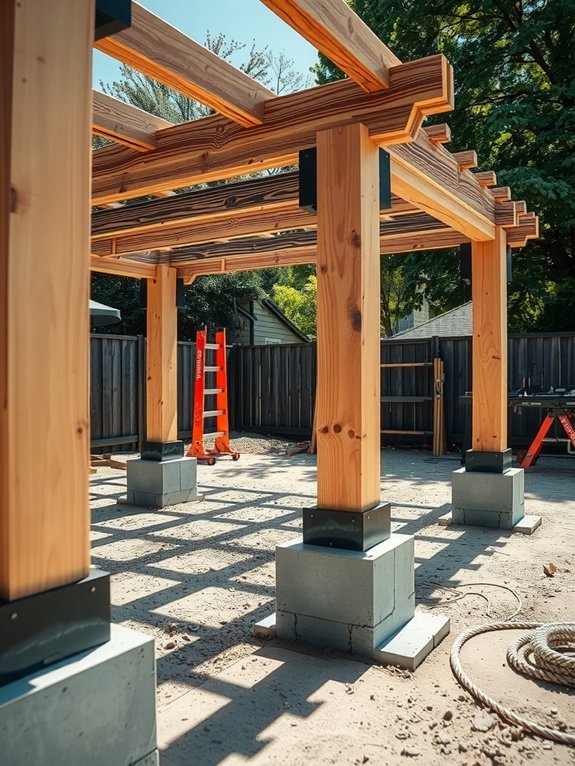
You’ll need to prepare your post holes carefully by filling the bottoms with gravel for drainage before setting your posts. Use concrete as your primary anchor, and while you’re working, verify that everything is plumb on all sides with a level and temporary 1×2 braces.
Once you’ve poured the concrete, recheck the plumb after the pour since drainage considerations can affect how things settle. Stabilize the curing posts with 2×4 or 2×6 bracing secured with galvanized screws or nails. This step prevents shifting and keeps your frame true as everything sets.
The combination of concrete anchoring and temporary bracing does require attention to detail, but it’s what keeps your pergola’s foundation solid when weight and weather put it to the test later on.
Digging and Hole Preparation
Your pergola’s stability depends on getting those six post holes right from the start. You need to dig them about 30 inches deep—that accounts for your local frost line and what kind of soil you’re working with—and roughly 24 inches wide.
Here’s what you should do:
- Put a few inches of gravel at the bottom of each hole. This helps water drain away and gives you a solid, level base for setting your posts.
- Use a long level to check that each post is perfectly plumb on all four sides as you place it.
- Brace your posts temporarily with 1×2 supports while the concrete sets.
Taking time to get these holes right prevents your posts from settling or shifting later on. That kind of movement can create real problems for your entire structure down the road.
Concrete Anchoring Methods
Once your posts are plumb and braced with temporary 1×2 supports, you’re ready to pour concrete. Mix your concrete according to the manufacturer’s instructions, then carefully fill each hole around the post while working out air pockets as you go. This part takes patience and attention to detail.
Let the concrete cure fully before you do anything else—plan on 24 to 48 hours depending on weather conditions and concrete type. After it’s cured, you can remove the temporary bracing and install permanent post braces using 2×4 or 2×6 lumber. Secure these braces with galvanized screws or nails, positioning them diagonally to enhance lateral stability and distribute loads effectively. This diagonal bracing approach gives your pergola the solid foundation it needs to stand up to wind and weather over time.
Bracing for Stability
You’ll dig six post holes—each about 24 inches wide and 30 inches deep—to form the backbone of your pergola. Start by putting down a 4-to-6-inch layer of gravel in each hole for drainage. This simple step keeps water from pooling under your posts and weakening them over time.
After pouring concrete around your posts, you still need to secure them properly. You have several bracing options to choose from:
- Attach 2×4 or 2×6 braces to your posts using galvanized screws or nails. This creates triangulated support that keeps the structure from shifting side to side.
- Install post brackets or bases before pouring concrete. This gives you a reinforced anchor point right from the start.
- Check that all posts are plumb using a level on all four sides while the concrete cures. Use temporary 1×2 supports to hold everything straight during this time.
These methods work together to give your pergola the solid, rigid foundation it needs to stand up to weather and use.
Install Beams and Bolted Connections
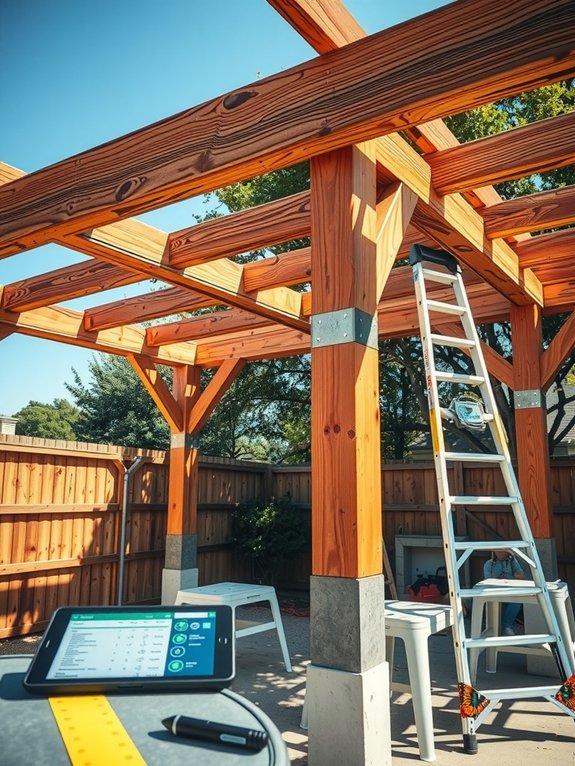
Install Beams and Bolted Connections
How you secure your beams to the posts will largely determine whether your pergola stays solid or develops a wobble that gets worse over time. Start by marking where you want each beam to sit on the posts. Temporarily brace the beams with 2x3x12 studs to hold them in place while you work.
Use a long auger bit to drill straight through both the beams and posts. These holes will accept your galvanized bolts, washers, and nuts. The key here is precision—drill as straight as you can so the hardware seats properly. Once you’ve drilled your holes, insert the bolts carefully and thread on the washers and nuts.
Tighten these connections snugly. When done right, bolted connections create a rigid framework that locks separate pieces into one unified structure. This rigidity is what allows your pergola to handle years of weather exposure and regular use without developing flex or movement.
Attach Shade Joists and Set Spacing
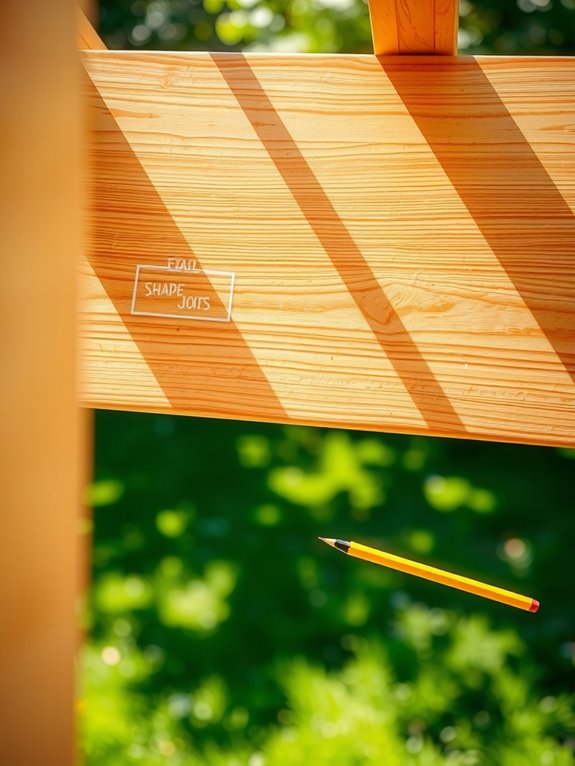
Attach Shade Joists and Set Spacing
Where your shade joists land on those beams will determine both how your pergola looks and how much filtered light reaches below. This is worth planning carefully before you start driving fasteners, since getting it right makes the difference between a structure that looks intentional and one that just exists.
Shade joist placement determines both aesthetics and light filtration—plan carefully before fastening to avoid a structure that merely exists rather than one intentionally designed.
Your 4x4x12 shade joists need deliberate positioning. Space them between 16 inches and 10 inches apart, depending on how much light you want filtering through. Tighter spacing blocks more light, while wider spacing lets more through. Drive screws at 45-degree angles on both sides of each joist to maximize their holding power against seasonal wood movement. Before you tighten everything down, align each joist flush against the cross-beams to ensure structural integrity.
Once you’ve got the layout assembled, compare it against your SketchUp renderings. Adjust your spacing as needed until the visual balance matches what you designed. This iterative step takes time but pays off when you’re looking at the finished pergola.
Seal, Stain, and Finish Your Pergola
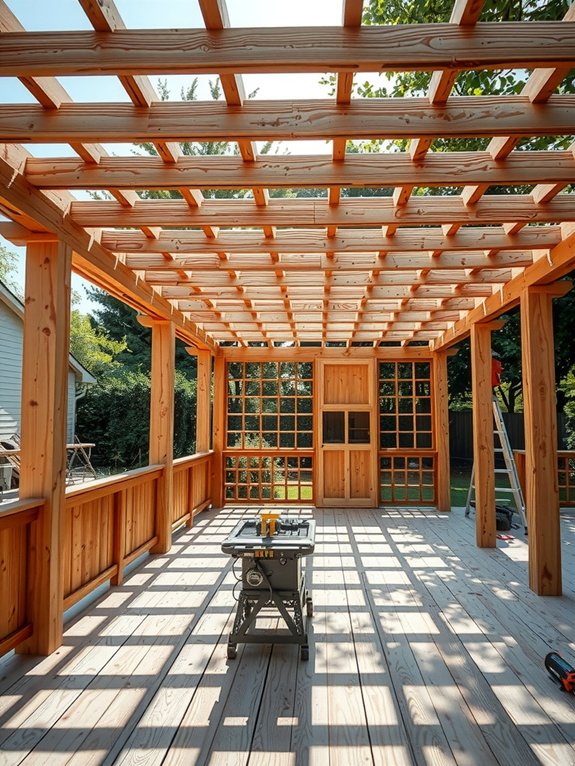
Protecting your pergola’s wood from the elements is where durability really gets decided. All that structural work doesn’t mean much if moisture seeps in and rot takes hold. Before you apply any finish, you need to sand the wood smooth, remove all the dust thoroughly, and wipe everything down with a tack cloth. This prep work guarantees that your finish will stick evenly and look professional.
| Finish Type | Best For | Reapply Frequency |
|---|---|---|
| Exterior Latex Stain | Easier cleanup | Every 2–3 years |
| Water-Based Sealer | Eco-conscious builders | Every 2–4 years |
| Solvent-Based Sealer | Maximum durability | Every 3–4 years |
| Combination Stain-Sealer | Time-savers | Every 2–3 years |
| Clear Protective Coat | Natural wood lovers | Every 2–4 years |
Pay special attention to the bottom 24 inches of your posts—that’s where moisture damage typically starts. Make sure you seal that area well. Apply your finish when the weather is dry and mild, check on it every three months, and you’ll keep that protective coating in good shape for years.
Plant Climbing Vines and Enhance Your Pergola
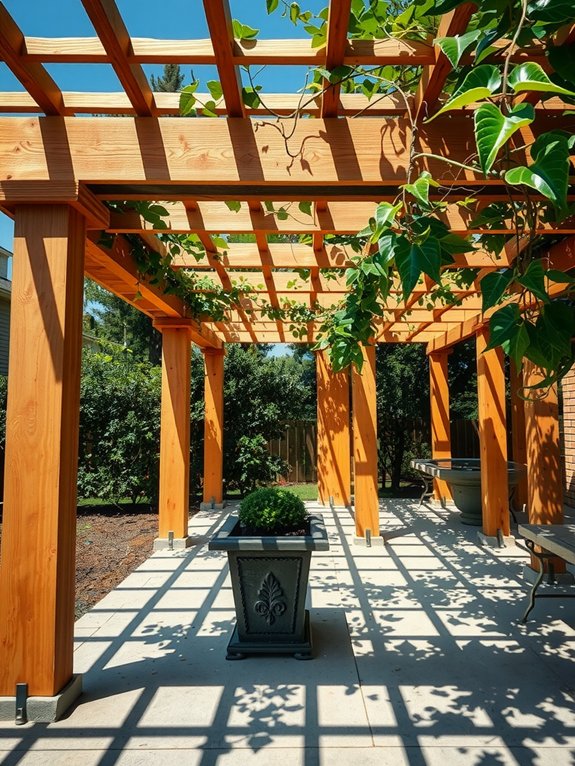
Once your pergola‘s structure has been sealed and protected, you’re ready to cover it with climbing vines. The key is picking species that match your site’s sunlight and how much time you can dedicate to maintenance.
A few solid options to consider:
- Wisteria, trumpet vine, or climbing roses grow quickly in full sun and fill in your pergola efficiently
- Lattice or upright training systems guide growth using garden ties or soft twine, so you won’t damage the wood
- Regular pruning keeps vines from getting too heavy on the rafters and helps them grow thicker
Water your vines deeply but infrequently to build strong roots, and make sure water drains away from the base. With consistent upkeep, your pergola becomes a real retreat rather than just a structure. You’ll notice the difference season after season.