

You’ll build your wire trellis by gathering a few key materials first. Pick up galvanized steel rope, screw eye hooks, and masonry anchors that match your mounting surface—whether that’s a fence, wall, or freestanding frame.
Start by sketching a diamond pattern on paper, then transfer those measurements to where you’re installing the trellis. Use tape to mark your points, then drill the anchor holes with fasteners appropriate for your surface, whether brick or wood.
Thread 1/16-inch wire through a double loop setup, then add turnbuckles so you can adjust the tension as seasons change. Secure everything with ferrules and stainless steel hooks. You’ll want to pay special attention to your spacing and how you center the pattern on your mounting surface, since these details affect both how the trellis looks and how well it functions.
Choose Your Wire Trellis Materials and Tools
First, figure out where your trellis will go—against a fence, wall, or standing on its own frame. This choice determines what you’ll actually need to buy.
For the wire itself, grab three 50-foot packs of 1/16th inch galvanized uncoated steel wire rope. This gauge gives you the strength and visibility that keeps your structure working properly over time. You’ll pair these with one pack of aluminum ferrules, which create the secure loops that connect your wire to the anchor points.
Your anchor points come from 22 stainless steel screw eye hooks. Space these hooks consistently across your mounting surface to keep your wire pattern even and functional.
If you’re attaching to masonry, you’ll need brick anchors and should rent a hammer drill with masonry bits for the installation. Add a turnbuckle to your list as well—this adjustable piece of hardware lets you tighten or loosen the wire tension as needed. Once your vines get established and heavier, you’ll appreciate being able to make those adjustments without taking everything apart.
Mark Your Diamond Pattern and Drill Anchor Points
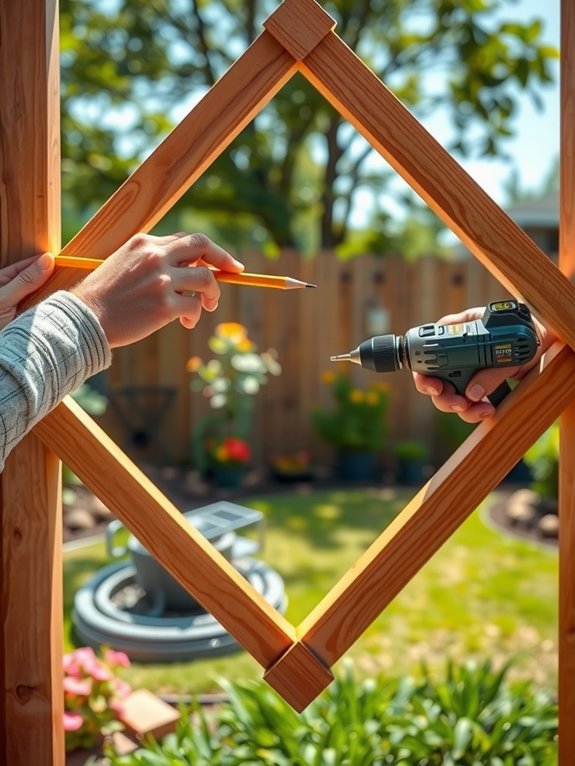
Planning your diamond pattern before you pick up a drill or marker really does make a difference. A well-designed trellis looks intentional, while a poorly planned one shows misaligned intersections and uneven spacing that signal amateur work. Start by sketching your design on paper or in Photoshop to check that proportions are centered. Once you’re satisfied with the design, transfer your measurements to the actual substrate using tape or a marker, and keep your spacing consistent at 25 units throughout.
| Step | Action | Verification |
|---|---|---|
| 1 | Mark anchor points on surface | Connect virtual points visually |
| 2 | Verify alignment from all angles | Diamond grid appears balanced |
| 3 | Confirm substrate preparation | Use appropriate anchors for material |
Before you drill, compare your planned wire runs against the actual layout on your substrate. This step prevents the misaligned intersections that happen when you skip ahead. You also need to choose the right anchors for your material—brick anchors for masonry, for example—and verify that your drill bit size matches your fasteners before you start preparing the substrate.
Thread and Tension Your Wire for Stable Growth
Thread your 1/16 inch galvanized steel wire rope from anchor to anchor in a double loop configuration. This doubled setup distributes tension evenly across your pattern and prevents sagging as your vines mature and gain weight over time.
Use a turnbuckle at strategic points along the wire. This lets you adjust how tight the wire sits whenever seasons change, so you won’t have to take apart your entire trellis to make tweaks.
Make sure your wire rope stays properly tensioned through your stainless steel hooks and ferrules. When everything’s secured correctly, you get a framework that’ll hold up reliably for years without constant maintenance or reinforcement.